The control layer for your business data.
Your ERP, point of sale, e-commerce and warehouse each hold a version of the same business. Mosaic tells you when they stop agreeing — and why.
Runs where your data lives · cloud, hybrid or on-premise
Find why your data doesn't match. Before it impacts your business.
One definition of what should agree, run on a schedule.
Unmapped tender types “Visa” and “PayPal” on the integration interface.
- SAYSThe tills recorded them; the interface log reports an error on all 37.
- SAYSAll 37 errors are in 4 of 250 stores, and none has posted since 19 August.
- NEVER“The point of sale is wrong.”
Mosaic reads whatever your systems run on, compares them against a rule you wrote once, and spends its effort on the only question worth answering: why don't they agree?
Sales, inventory, orders. Every one of them lives in more than one system.
Each number below is correct inside the system that produced it. That is what makes the disagreement so expensive to find.
Sales
Yesterday, all storesInventory
Units on handOrders
This weekReconciles the systems you already run
You already have a reconciliation process. But it runs on Excel.
Nobody bought it. It accumulated — a query here, a pivot there, a person who knows which tab to trust. Mosaic is not competing with a platform. It is competing with that process.
SELECT store, SUM(net)FROM pos_salesGROUP BY store;
Query 1POS
SELECT site_code, SUM(amount)FROM erp_postingsGROUP BY site_code;
Query 2ERP
0 2 * * *
Cron script02:00 daily
=VLOOKUP(A2, ERP!$A:$D, 4, FALSE)
VLOOKUPby hand
Anyone can tell you two numbers differ. Mosaic tells you why, how and more.
A difference you cannot act on is a ticket. Mosaic hands over the same difference with the evidence already gathered.
You write the runbook once — the queries a good analyst would run, in the order they would run them. Every difference after that arrives with it already carried out.
A question the rest of the stack never asks.
Your pipelines can be healthy, your data valid and every system internally correct — and the business still has three answers to one question.
Mosaic learns how your business is wired.
A pack brings a system's vocabulary with it, so a reconciliation starts from orders, stores and stock rather than from column names. What Mosaic learns about your estate stays yours and compounds — after six months it knows the wiring nobody wrote down.
Someone repurposed the field years ago and nobody renamed it. Mosaic reads the values, not the label — and asks you to confirm before it believes itself.
The same question, everywhere.
Two systems hold a version of one business fact. Mosaic does not care which industry they belong to, or whether either one is a database.
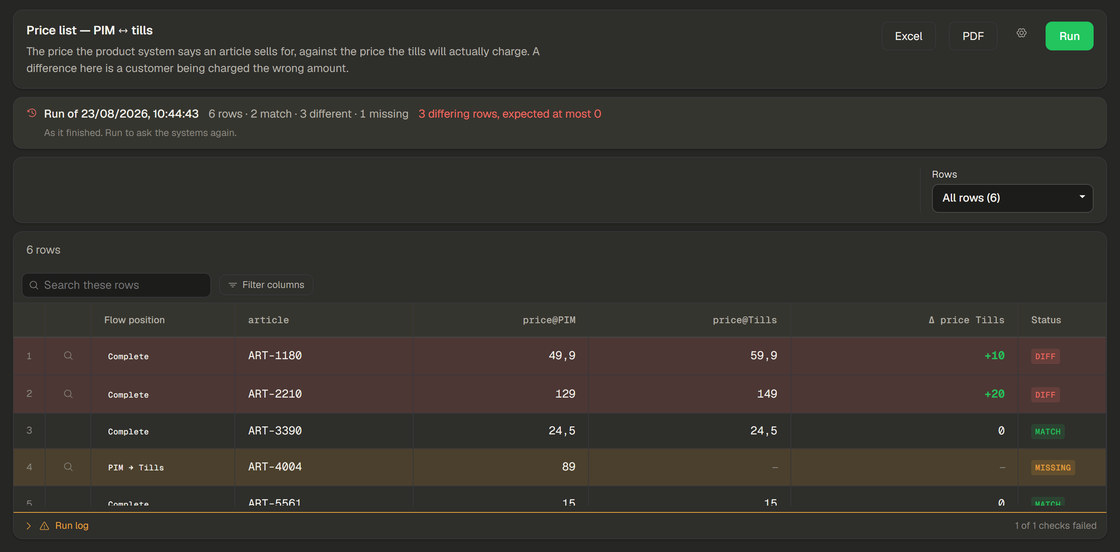
Pick two systems that ought to agree.
Connect them, say what should match, and let Mosaic tell you what doesn't. The first answer takes an afternoon, not a project.
No per-source pricing · no per-user tax